Protective Grounding (Earthing) and Equipment Bonding
Plain-English definition
Two connected electrical safety practices that keep metal cabinets and enclosures safe to touch. Equipment bonding joins server racks, conduits, cable trays, and power enclosures with low-resistance metal paths so they stay at the same voltage. Protective grounding (earthing) connects that bonded metal network to the building earth electrode and power-source reference.
Why it matters on shift
If a live wire rubs against a metal rack frame or power strip housing, a solid equipment bonding path carries high fault current back to the power source so the breaker trips immediately. An unbonded or floating rack frame can stay energized at lethal voltage without tripping the breaker.
Illustrative operational example
In an illustrative 277 V line-to-frame fault inside a cabinet under NFPA 70 (NEC Article 250) principles, a bonded metal return path of 0.10 ohm passes roughly 2,770 A, tripping a 30 A branch breaker in cycles. Trying to clear that same fault through soil alone via an isolated 25 ohm earth rod passes only about 11 A, leaving the cabinet frame dangerously energized.
Scope, code & safety boundary
Never lift an equipment bonding jumper to quiet signal noise, and never drive separate isolated ground rods disconnected from the facility Common Bonding Network (CBN). Conductor sizing, paint-penetrating hardware, and torque verification belong to qualified electricians under NFPA 70, NFPA 70E, and site Lockout / Tagout rules.

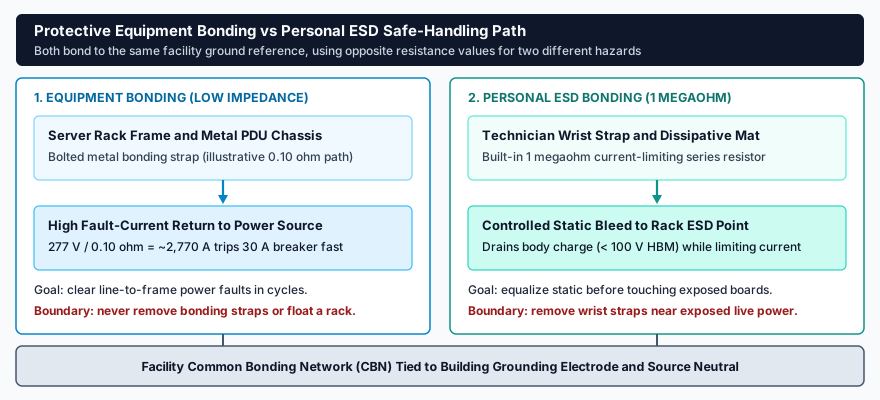
Both paths connect to the same facility Common Bonding Network, using opposite resistance values: below 0.1 ohm on metal frames to trip breakers fast during power faults, versus 1 megaohm in ESD wrist cords to drain static slowly while limiting shock current.
Read plain-text walkthrough of this diagram
Two-column comparison connected to the facility Common Bonding Network (CBN). Column 1 (Equipment Bonding) shows a server rack frame and metal PDU chassis bonded via an illustrative 0.10 ohm metal strap so a 277 V fault passes roughly 2,770 A back to the source and trips a 30 A breaker quickly; never remove bonding straps or float a rack. Column 2 (Personal ESD Bonding) shows a technician wrist strap and dissipative mat with a built-in 1 megaohm current-limiting resistor that drains static charge below 100 V (Human Body Model) to the rack ESD point; always remove wrist straps before working near exposed live power.
Related courses & interactive lab practice
Facility, rack & safety foundations
Critical power & dual-path feeds
Practice live readings and switching in "2N Blackout & Live Diesel Synchroscope" with no login required.
Primary standards & technical references