Advanced · Leadership · DOC-OPS-09

The Shift Lead

Shift Command, Multi-Crew Handovers & Reliability Culture

Lead 12-hour shift turnovers, concurrent vendor work permits, first-15-minute incident command, tabletop drills, and blameless debriefs across rotating crews.

Start Lesson 1 (~17 min open)
Open sample & effort
All 5 browser lessons & capstone open free (~85 min reading; no login).
Prerequisites
Runbook Under Pressure and Signal Room, or active experience leading technical operations. Designed for: Shift leads, senior critical-facilities engineers, chief engineers, and data center facility managers.
Tuition & cohort enquiry ($399 · $1,600 list)

Course outline · 5 open browser lessons (~85 min reading)

  1. 01The shift leader’s operating system~17 min read
  2. 0212-hour briefings, turnovers, and inhibited-alarm governance~16 min read
  3. 03First-15-minute incident command and stakeholder comms~18 min read
  4. 04Concurrent vendor permits and cross-domain risk~17 min read
  5. 05Tabletop drills, coaching, and blameless reliability culture~17 min read

Plus 1 unmeasured end-of-course capstone check and self-paced DOC-OPS-09 deliverable rubric in the open studio below.

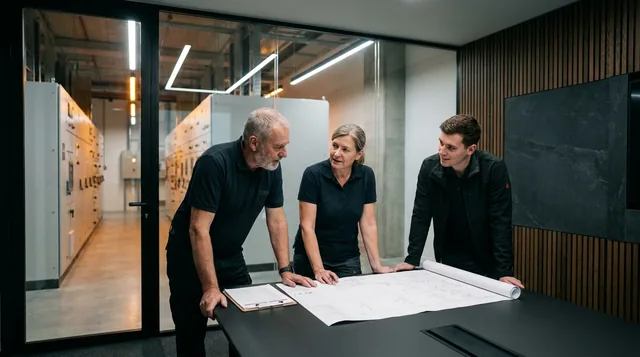
Multi-operator shift turnover command suite overlooking critical server rows
FIG. 01 · DOC-OPS-09Shift Command, Multi-Crew Handovers & Reliability Culture
Prerequisites
Runbook Under Pressure and Signal Room, or active experience leading technical operations. Designed for: Shift leads, senior critical-facilities engineers, chief engineers, and data center facility managers.
Study scope
Open now: ~85 min approximate reading across 5 interactive browser lessons (16 to 18 min each). Self-paced & unmeasured: end-of-course capstone check, paired Campus Shift exercise, and drafting your DOC-OPS-09 deliverable. Extended cohort scope: 8 hours extended syllabus & project scope.
Deliverable
Portfolio deliverable: A shift operating plan covering turnover boards, incident command roles, permit gates, and drill cadence. (DOC-OPS-09)
Tuition & enquiry
$399 self-paced tuition ($1,600 list). All 5 lessons below are already open free; submitting the enquiry form records your email for manual follow-up with no online card checkout or gated account login.
Progress & terms
6/6 lesson and capstone checks save in this browser (localStorage with session fallback). Independent professional-development training, not an accredited certificate/degree, trade license, vendor credential, or live-site switching authorization.
Paired Campus Shift station
Shift Turnover & Permit Desk (free interactive Campus Shift in browser)
Recommended next course
AI Density Lab: Pair multi-crew shift governance with 120 kW direct-to-chip AI hall operations, or configure a private crew cohort via the Teams page.
Scope note & primary engineering references (3 cited)

Open browser lessons total ~85 min approximate reading across 5 modules; the end-of-course capstone check, paired Campus Shift exercise, and self-paced DOC-OPS-09 deliverable draft are separate unmeasured practice outside the extended cohort scope (8 hours extended syllabus & project scope).

  • High-Reliability Organization (HRO) Principles (Weick & Sutcliffe: preoccupation with failure, reluctance to simplify, deference to expertise)
  • Incident Command System (ICS / NIMS) adapted for critical-facilities shift operations (span of control, single incident commander, comms separation)
  • Uptime Institute Operational Sustainability & Human Performance Standards (concurrent maintenance governance, shift turnover, and drill cadence)

Interactive self-paced studio

Study The Shift Lead right now, at your own pace.

Self-paced progress · 0/6 checkpoints verified
Lesson 1 of 5 · ~17 min studio (95 min syllabus scope)

The shift leader’s operating system

Key terms defined in plain language first
Helicopter View (Command Perspective)

Stepping back from hands-on wrench turning during complex windows or alarms so one person continuously tracks whole-campus redundancy, time budgets, and cross-system interactions.

If the Shift Lead buries their head inside UPS-B1, nobody notices Chiller 3 alarming in the next gallery!Encyclopedia: Incident Commander (IC) Role and Helicopter View
Psychological Safety for Stop-Work

How visibly a leader rewards, and never sighs at or penalizes, a junior technician who pauses a switching window over a confusing label or meter discrepancy.

One sarcastic eye-roll from a Shift Lead teaches a new hire to stay silent on the next real wrong-breaker mistake.Encyclopedia: Stop-Work Authority (SWA)
Explicit Decision Authority Matrix

Knowing before the shift starts which calls an operator makes immediately (safety stop, EOP start), which the Shift Lead approves (permit hold, vendor pause), and which require Engineering/Facility Manager sign-off (MOP redline).

Eliminates dangerous 'I thought you were calling on-call' hesitation.
Field engineering briefing

When a senior technician gets promoted to Shift Lead, the biggest trap is acting like the 'Super-Technician': diving head-first into the nearest open cabinet with a multimeter while nobody watches the rest of the building. A great Shift Lead steps back half a pace to hold the whole operational picture, protect psychological safety to call a stop, and keep decision ownership crystal clear.

Setting operational tempo, psychological safety to call a hold, and explicit decision ownership.

Voice tempo and how you react to a good-faith false stop

Crews mirror their Shift Lead's nervous system: a calm, measured voice at 110 words per minute slows heart rates across the radio, whereas barked interruptions breed mistakes. Even more important is how you respond when a trainee halts an MOP over a stencil ('52-1B' vs '52-B1') that turns out to be a benign legacy typo: thanking them in front of the crew, logging a formal label redline/CAPA, and never calling it a 'false alarm' cements the exact habit that saves the plant next month.

Letting technicians execute while you hold the boundary

Coaching a strong crew means delegating reader-doer execution to qualified technicians while you audit preconditions, guard time clocks, and shield your floor crew from stakeholder phone interruptions.

System state-change diagram

Leadership Fork: Punishing vs Backing a Good-Faith Label Stop

Viewing: 2. Trigger: Tech Invokes Stop-Work at 02:10
Swipe sideways on narrow screens · Node values below
Immediate Plant State15-min pause at safestepToxic Response (Trap)Tech embarrassed onradioHigh-Reliability LeadCallEngineering issuesformal redline6-Month Crew OutcomeWhole crew checksstencils closely
  1. 1. Immediate Plant State15-min pause at safe step
  2. 2. Toxic Response (Trap)Tech embarrassed on radio
  3. 3. High-Reliability Lead CallEngineering issues formal redline
  4. 4. 6-Month Crew OutcomeWhole crew checks stencils closely

Trace the six-month cultural consequence of how a Shift Lead handles a junior tech's 15-minute pause over a mismatched placard.

Accessible text walkthrough & 3-state comparison table

When a junior tech halts over '52-1B' vs '52-B1', dismissing them silences future warnings, whereas publicly backing the stop, obtaining a formal redline, and fixing the engraved placard strengthens crew-wide defense.

System node1. Tech Spots '52-1B' vs '52-B1'2. Tech Invokes Stop-Work at 02:103. Public Backing + Label CAPA Filed
Immediate Plant StateZero breakers moved15-min pause at safe step100% load protected
Toxic Response (Trap)'Everyone knows what it meant'Tech embarrassed on radioNext real mismatch goes unspoken!
High-Reliability Lead Call'Good catch, hold right there'Engineering issues formal redlineEngraved placard CAPA opened
6-Month Crew OutcomeClear standard modeledWhole crew checks stencils closelyWrong-cabinet error rate drops

When a junior tech halts over '52-1B' vs '52-B1', dismissing them silences future warnings, whereas publicly backing the stop, obtaining a formal redline, and fixing the engraved placard strengthens crew-wide defense.

  • Immediate Plant State: Tech Spots '52-1B' vs '52-B1' = Zero breakers moved; Tech Invokes Stop-Work at 02:10 = 15-min pause at safe step; Public Backing + Label CAPA Filed = 100% load protected.
  • Toxic Response (Trap): Tech Spots '52-1B' vs '52-B1' = 'Everyone knows what it meant'; Tech Invokes Stop-Work at 02:10 = Tech embarrassed on radio; Public Backing + Label CAPA Filed = Next real mismatch goes unspoken!.
  • High-Reliability Lead Call: Tech Spots '52-1B' vs '52-B1' = 'Good catch, hold right there'; Tech Invokes Stop-Work at 02:10 = Engineering issues formal redline; Public Backing + Label CAPA Filed = Engraved placard CAPA opened.
  • 6-Month Crew Outcome: Tech Spots '52-1B' vs '52-B1' = Clear standard modeled; Tech Invokes Stop-Work at 02:10 = Whole crew checks stencils closely; Public Backing + Label CAPA Filed = Wrong-cabinet error rate drops.
Worked engineering example

Workload & watch-coverage allocation across a 4-person 12-hour shift

Given scenario

Illustrative shift-plan budget: Night shift runs 19:00 to 07:00 (12 hours) with 1 Shift Lead + 3 Operators. Tonight's docket includes: continuous BMS/EPMS console watch (12 hrs), two campus-wide physical rounds (2 × 75 min = 2.5 person-hrs), one 2-person switching MOP-604 (01:00 to 03:30 = 2.5 hrs × 2 people = 5.0 person-hrs), and mandatory meal/fatigue breaks.

  1. Step 1

    Verify console coverage never drops to 0 during MOP-604 (01:00 to 03:30): Assign Op 1 + Op 2 as dedicated Reader-Doer pair on MOP-604; assign Op 3 to continuous BMS/EPMS console watch; Shift Lead holds roving command + stakeholder bridge.

  2. Step 2

    Check circadian fatigue & break rotation: Complete Round 1 (19:45 to 21:00) and staggered meal breaks BEFORE 00:30 so Op 1, Op 2, and Op 3 enter the 01:00 to 03:30 critical switching window rested and unhurried.

  3. Step 3

    Reserve surge buffer: Schedule ZERO concurrent vendor escorts during 01:00 to 03:30 so if an unplanned alarm hits at 02:00, Shift Lead + Op 3 can triage immediately while Op 1/Op 2 hold MOP-604 at a safe boundary.

Operational takeaway: Shift reliability is math as well as culture: never book concurrent tasks that leave zero dedicated eyes on the console or force tired solo work at 02:30 AM.
Optional depth · Scope boundaries & modeling assumptions

Scope & assumptions: Crew sizes (2-person small edge site vs 6 to 12 person hyperscale campus shift) scale the numbers, while dedicated console watch and two-person switching rules remain constant.

Optional reference table · DOC-OPS-09: Shift Command Charter & Stop-Work Escalation Standard

Establishes leadership tempo, authority tiers, and crew staffing rules at the top of DOC-OPS-09.

FieldIllustrative entryVerification rule
Unconditional Stop-Work RuleAny tech halts immediately on label/meter/permit mismatch; Shift Lead backs call 100%.Every stop-work generates a tracked label/procedure CAPA, never informal workarounds.
Console Watch Red-Line≥1 qualified operator continuously assigned to integrated BMS/EPMS console 24/7.Defer non-urgent escorts if floor work would leave the control room unattended.
Lead Helicopter PostureShift Lead remains hands-off tools/keyboards during multi-tech MOPs and EOPs.If Lead must step in technically, explicitly hand Incident Command to Senior Tech first.
Operator field checklist (check off as you review)
Graded checkpoint · Counts toward 6/6Module 1 of 5 verification

As Shift Lead, how do you handle the technician and the discrepancy right now?

At 01:50 AM, a newly hired technician halts Step 6 of a scheduled PDU switching MOP because the physical breaker placard reads '52-B1' while the printed MOP says '52-1B.' Engineering confirms by phone 12 minutes later that it is a legacy stencil typo on the right breaker, leaving the window tight.

Lesson 1 of 5 · Open browser studio

Capabilities

What you will verify on shift.

  • Establish stop-work authority, active-risk turnover boards, and zero-gap 12-hour handover discipline
  • Separate incident command and stakeholder communications from hands-on technical troubleshooting
  • Audit concurrent maintenance permits to prevent cross-domain redundancy collisions across A/B paths
  • Run realistic EOP walkdown drills and blameless debriefs that fix system/procedure traps rather than blaming individuals

Portfolio Deliverable · DOC-OPS-09

What you build and keep.

A shift operating plan covering turnover boards, incident command roles, permit gates, and drill cadence.

  • Standardized 12-hour shift-turnover board covering degraded redundancy, inhibited alarms, and LOTO permits
  • First-15-minute incident command role split (Incident Lead, Panel Operator, Scribe/Comms) & update cadence
  • Quarterly tabletop/walkdown drill schedule and blameless corrective-action tracker

Recommended Next Course

AI Density Lab

Pair multi-crew shift governance with 120 kW direct-to-chip AI hall operations, or configure a private crew cohort via the Teams page.

Optional tuition-rate enquiry · Separate from the free open browser studio above (no payment card, checkout, or automated credential on this page)

Tuition & cohort enquiry

Reserve The Shift Lead ($399 tuition).

Reserve the $399 self-paced tuition rate ($1,600 list price). All published interactive studio modules on this page are open in your browser right now; submitting sends your rate inquiry for manual email follow-up with no automated billing or gated account creation here.

Advanced · ~85 min open lessons · 8 hours extended syllabus & project scope$1,600$399
The Shift Lead: Shift Command, Multi-Crew Handovers & Reliability Culture

Portfolio deliverable: A shift operating plan covering turnover boards, incident command roles, permit gates, and drill cadence.

Selected self-paced courseThe Shift Lead (Advanced) · $1,600 $399

No card or automated billing here · Sends a $399 rate inquiry ($1,600 list) on submit · Open browser studio above.