VLANs, IP Subnets, and Layer 3 Routing
Plain-English definition
Three networking building blocks that group and separate traffic across facility switches. A Virtual Local Area Network (VLAN) splits one physical switch into separate Layer 2 broadcast groups. An IP subnet assigns each group a block of numeric addresses. Layer 3 routing uses a gateway and firewall policies to control traffic between subnets.
Why it matters on shift
Without clean VLAN and routing separation, broadcast traffic reaches unrelated ports, and a misconfigured server or contractor laptop could reach Baseboard Management Controllers (BMCs) or Building Management System (BMS) controllers. Clear boundaries isolate tenant networks, out-of-band server management, and facility control systems.
Illustrative operational example
In an illustrative rack management design using IEEE 802.1Q VLAN tags and Classless Inter-Domain Routing (CIDR, RFC 4632), VLAN 120 carries out-of-band BMCs on private IPv4 subnet 10.20.12.0/24 (256 total addresses, yielding 254 usable host addresses from 10.20.12.1 to 10.20.12.254 after reserving .0 network and .255 broadcast), with 10.20.12.1 as the Layer 3 gateway. Tenant traffic stays on VLAN 220, and firewall rules block tenant-to-BMC connections.
Scope, code & safety boundary
A VLAN tag separates Layer 2 switch traffic, but it does not encrypt packets and does not block traffic if a Layer 3 router connects two VLANs without firewall access-control lists. Always confirm port VLAN assignment before patching cables, and escalate routing or firewall rule changes to authorized network or Operational Technology (OT) security engineers.
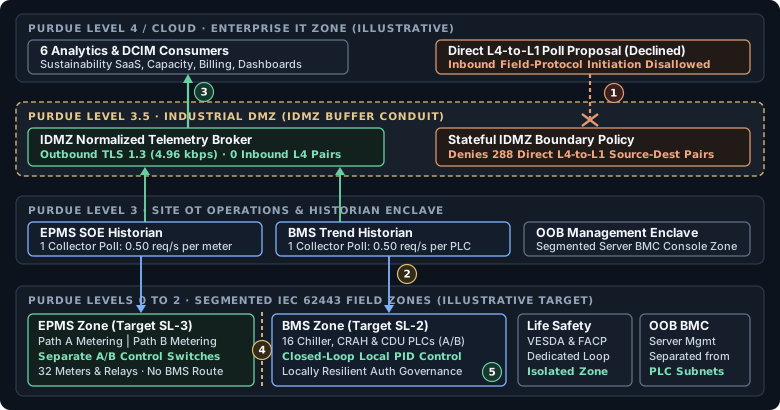
Industrial control networks separate field sensors, PLCs, and site BMS/EPMS servers from corporate IT networks by routing remote sessions through a supervised Level 3.5 jump-host conduit rather than direct firewall bypasses.
Read plain-text walkthrough of this diagram
Diagram shows Purdue Levels 4/5 Enterprise IT separated by firewall conduits from Level 3.5 OT DMZ (bastion jump host, MFA, session recording, patch staging), Level 3 Site BMS/EPMS historians, Level 2 HMI supervisory screens, and Levels 0 to 1 switchgear relays, UPS controllers, and chiller PLCs. Highlights why dual-homed laptops or cellular modems plugged directly into Level 1 PLCs bypass every upstream control.
Related courses & interactive lab practice
Physical & control-network (OT) security
Building/power monitoring & alarm triage
Facility, rack & safety foundations
Practice live readings and switching in "NOC, Spine-Fiber & White-Space Walkdown" with no login required.
Primary standards & technical references