Backup vs Replication, Recovery Point Objective (RPO), and Recovery Time Objective (RTO)
Plain-English definition
Core data-recovery concepts that separate live hardware failover from historical rollback. Replication copies storage writes to a second system almost immediately so workloads survive hardware failures. A backup stores separate point-in-time copies. Recovery Point Objective (RPO) is the maximum age of lost data tolerated, and Recovery Time Objective (RTO) is how fast service must return.
Why it matters on shift
Live replication is not a backup. When a bad script deletes records or ransomware encrypts storage, synchronous or near-real-time replication copies that damage straight to the replica within seconds. Only isolated, immutable, tested backups let teams restore clean data from before the incident.
Illustrative operational example
In an illustrative recovery plan following NIST SP 800-34 definitions, a service sets a 15-minute RPO and a 2-hour RTO with immutable snapshots every 15 minutes. After a faulty update corrupts tables at 10:14 UTC, engineers stop writes, restore the clean 10:00 UTC snapshot (losing 14 minutes of writes, within the 15-minute RPO), and reopen verified traffic at 11:40 UTC (86 minutes outage, within the 2-hour RTO).
Scope, code & safety boundary
Redundant 2N facility power and storage replication protect against equipment or room failure, not software bugs, accidental deletion, or stolen admin credentials. Backups must use separate administrative accounts and regular timed restore drills to prove real recovery meets the target RTO.

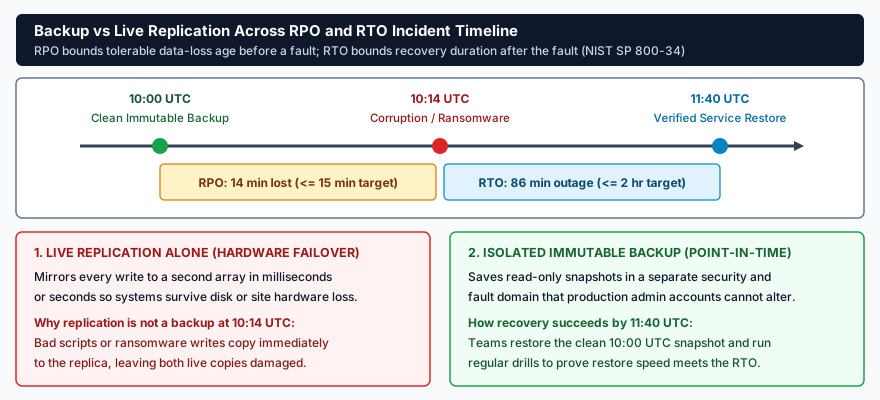
Recovery Point Objective (RPO) bounds how much pre-fault data age can be lost; Recovery Time Objective (RTO) bounds post-fault outage time. Live replication survives hardware loss, while isolated immutable backups recover from logical corruption or ransomware.
Read plain-text walkthrough of this diagram
Incident timeline from 10:00 UTC (clean immutable backup) through 10:14 UTC (corruption or ransomware event, showing a 14-minute data-loss window inside a 15-minute RPO target) to 11:40 UTC (verified service restore after an 86-minute outage inside a 2-hour RTO target). Left comparison card explains that live replication copies bad writes or ransomware immediately to the secondary array. Right card explains that isolated read-only snapshots in a separate security domain allow clean point-in-time rollback when regularly tested.
Related courses & interactive lab practice
Facility, rack & safety foundations
Physical & control-network (OT) security
Shift command, permits & reliability
Practice live readings and switching in "NOC, Spine-Fiber & White-Space Walkdown" with no login required.
Primary standards & technical references