Exhaust Air Recirculation
Plain-English definition
The unintended mixing of hot air discharged from the back of IT cabinets back into the cold intake stream at the front of cabinets, typically over uncontained rack tops, around row ends, through missing blanking panels, or whenever aisle supply flow falls short of server fan demand.
Why it matters on shift
Recirculation creates localized top-of-rack hot spots even when CRAH supply temperatures are cold, tricking operators into wasting chiller energy instead of fixing the physical airflow leak or fan under-supply.
Illustrative operational example
In the illustrative Pod A2 scenario, 16.0°C CRAH supply air mixed with 40% hot exhaust wrap-around produces 33.4°C server inlet temperatures until blanking panels and roof doors reduce recirculation to 0%.
Scope, code & safety boundary
Eliminating recirculation does not arise from colder supply air alone; always verify positive cold-aisle differential pressure so server fans draw 100% conditioned supply air.

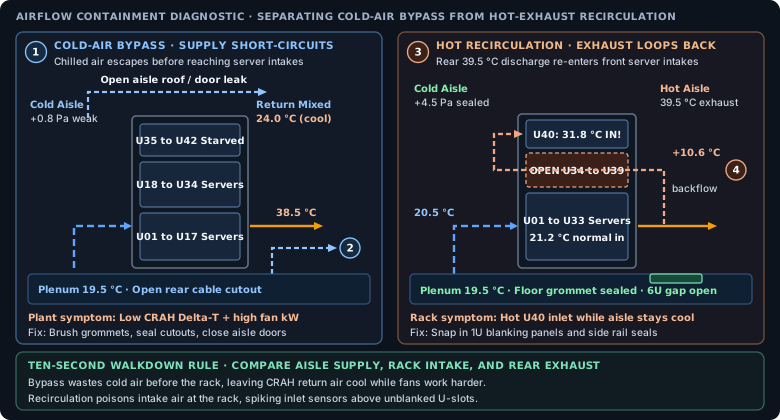
Bypass leaks chilled supply air back to the cooling unit before it ever cools a server. Recirculation pulls hot rear exhaust back into front server intakes through missing blanking panels or unsealed rail gaps.
Read plain-text walkthrough of this diagram
Left panel shows 19.5 degrees Celsius plenum supply air escaping through open cable cutouts and roof gaps straight to the return stream; return air reads a falsely cool 24.0 degrees Celsius while fans run high and upper U-slots starve. Right panel shows sealed floor grommets and +4.5 Pa cold-aisle pressure alongside open U34 to U39 slots; 39.5 degrees Celsius rear exhaust loops through the 6U opening into U40, pushing U40 intake to 31.8 degrees Celsius even though the aisle wall sensor stays cool.
Related courses & interactive lab practice
Air, chilled-water & liquid cooling
Practice live readings and switching in "35 kW Hot/Cold Aisle Containment Lab" with no login required.
Primary standards & technical references