Power Usage Effectiveness (PUE, ISO/IEC 30134-2)
Plain-English definition
The international standard ratio (ISO/IEC 30134-2) of total annual data-center facility energy consumption (including cooling, power-conversion losses, lighting, and auxiliaries) divided by the energy consumed strictly by IT equipment. Ideal zero-overhead efficiency equals 1.0; lower values above 1.0 indicate less non-IT electrical overhead.
Why it matters on shift
Tracking PUE shows how strongly cooling-plant staging, fan speeds, and UPS losses multiply IT power draw, while reminding engineers that optimizing PUE must never breach thermal or water-permit limits.
Illustrative operational example
At an illustrative 8.0 MW IT load, running at PUE 1.25 draws 10.0 MW total facility power (2.0 MW overhead), whereas unlocking wetted WSE pre-cooling on two chillers at PUE 1.16 cuts total draw to 9.28 MW, saving 720 kW.
Scope, code & safety boundary
ISO/IEC 30134-2 defines annual energy (kWh) across measurement categories PUE1 (UPS output), PUE2 (PDU output), and PUE3 (IT inlet); instantaneous heatwave power ratios are operational telemetry, not certified annual PUE.
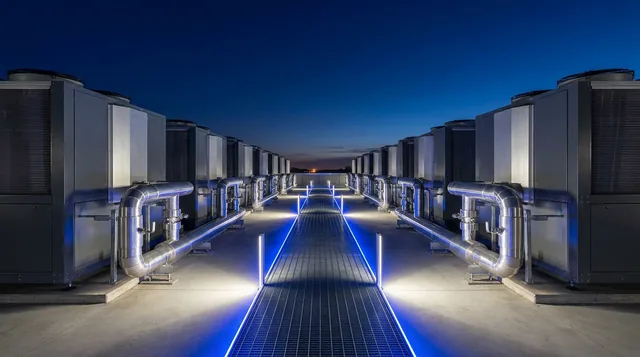
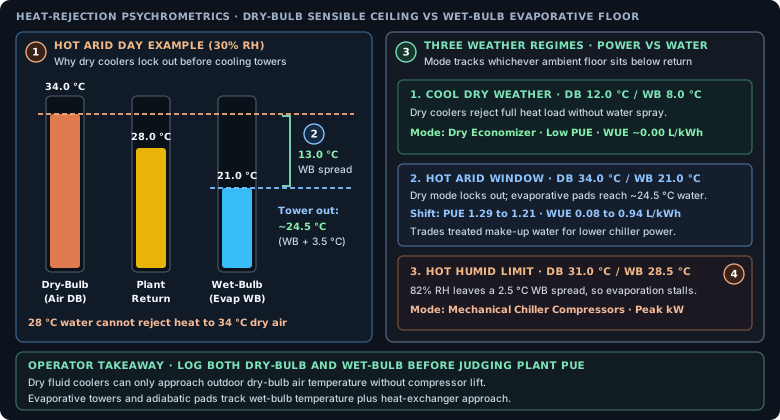
Dry coolers reject heat only down toward outdoor dry-bulb air temperature. Evaporative towers and adiabatic pads can cool water closer to wet-bulb temperature on hot dry days, trading water consumption (WUE) for lower chiller power (PUE).
Read plain-text walkthrough of this diagram
Left chart compares 34.0 degrees Celsius dry-bulb air, 28.0 degrees Celsius plant return water, and 21.0 degrees Celsius wet-bulb temperature at 30% relative humidity (13.0 degrees Celsius wet-bulb spread). Because 28.0 degrees Celsius water is cooler than 34.0 degrees Celsius dry air, dry free cooling locks out, whereas evaporative cooling approaches wet-bulb plus 3.5 degrees Celsius approach (~24.5 degrees Celsius water). Right panel compares Cool Dry weather (12.0 degrees Celsius DB, dry economizer, near-zero water), Hot Arid weather (34.0 degrees Celsius DB / 21.0 degrees Celsius WB, PUE improves from 1.29 to 1.21 while WUE rises from 0.08 to 0.94 L/kWh), and Hot Humid weather (31.0 degrees Celsius DB / 28.5 degrees Celsius WB, evaporation stalls and chillers carry full mechanical lift).
Related courses & interactive lab practice
Physical & control-network (OT) security
Energy, water & capacity accounting
Practice live readings and switching in "Heatwave Economizer & PUE/WUE Balance" with no login required.
Primary standards & technical references