Water Usage Effectiveness (WUE, ISO/IEC 30134-9) and Blowdown
Plain-English definition
The international standard metric (ISO/IEC 30134-9) dividing annual net site water consumption (predominantly cooling-tower evaporation, drift, mineral-control blowdown, and adiabatic pad wetting) by annual IT equipment energy consumption, expressed in liters per kilowatt-hour (L/kWh).
Why it matters on shift
Power and water sit on a coupled seesaw during hot weather: evaporative cooling lowers condensing temperatures and PUE, whereas higher cycles of concentration and throttled wetting conserve municipal water under drought permits.
Illustrative operational example
In the illustrative 8.0 MW heatwave lab (420 L/min drought cap), Stage 1 pad wetting (168 L/min) plus two water-cooled chillers (72 L/min condenser makeup and blowdown) totals 240 L/min (~1.80 L/kWh instantaneous rate), whereas Max Wet Mist (462 L/min) breaches the permit.
Scope, code & safety boundary
Site WUE excludes upstream water evaporated at utility power plants; pushing cycles of concentration too high without water treatment causes scale buildup on condenser tubes and adiabatic media.
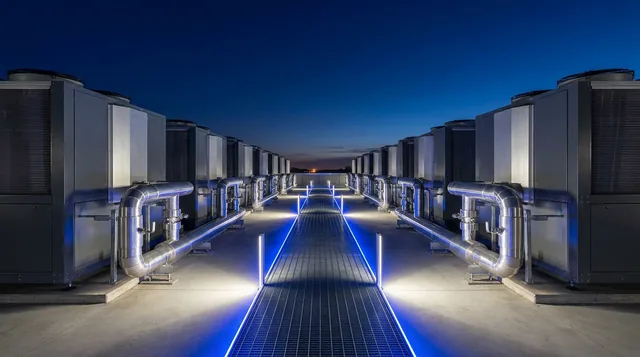
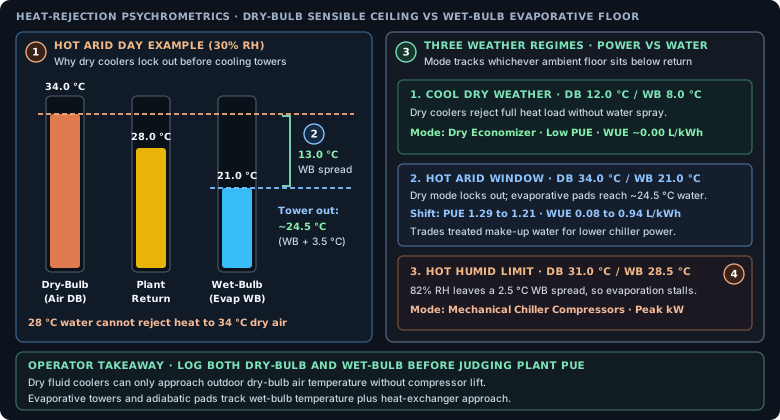
Dry coolers reject heat only down toward outdoor dry-bulb air temperature. Evaporative towers and adiabatic pads can cool water closer to wet-bulb temperature on hot dry days, trading water consumption (WUE) for lower chiller power (PUE).
Read plain-text walkthrough of this diagram
Left chart compares 34.0 degrees Celsius dry-bulb air, 28.0 degrees Celsius plant return water, and 21.0 degrees Celsius wet-bulb temperature at 30% relative humidity (13.0 degrees Celsius wet-bulb spread). Because 28.0 degrees Celsius water is cooler than 34.0 degrees Celsius dry air, dry free cooling locks out, whereas evaporative cooling approaches wet-bulb plus 3.5 degrees Celsius approach (~24.5 degrees Celsius water). Right panel compares Cool Dry weather (12.0 degrees Celsius DB, dry economizer, near-zero water), Hot Arid weather (34.0 degrees Celsius DB / 21.0 degrees Celsius WB, PUE improves from 1.29 to 1.21 while WUE rises from 0.08 to 0.94 L/kWh), and Hot Humid weather (31.0 degrees Celsius DB / 28.5 degrees Celsius WB, evaporation stalls and chillers carry full mechanical lift).
Related courses & interactive lab practice
Energy, water & capacity accounting
Practice live readings and switching in "Heatwave Economizer & PUE/WUE Balance" with no login required.
Primary standards & technical references